The Crucible
The Crucible is our software framework. It guides teams as they put agreed practices to work and documents the emerging operating model. The resulting record, the digital twin, shows who does the work, who can decide, what the work costs and returns, and which practices hold.
Our consulting does not require our software. You can work with us on strategy, use-case selection, responsibilities and practices without buying or installing it. We agree the scope of the consulting with you and discuss separately whether the software would help.
How software supports the consulting
Our Forward Deployed Builders help you decide what to change, build alongside your teams and measure the value delivered. The software supports that work between reviews: it gives teams guidance inside their AI tools, checks agreed practices as they build and keeps the evidence in your own repositories. A builder and a leader can then review what actually happened, including missing evidence and unresolved decisions.
That is useful when you need to see whether a practice holds across several teams, or whether a change to ownership or approvals improves the work. The record develops with each release, so the next discussion can start from what changed. You may already have tools and records that serve those purposes; our advice can stand on its own.
Guidance and checks inside the team's work
The nine disciplines provide a starter set for what an Agentic Operating Model might look like. Their 106 practices are written as skills that guide teams inside the AI tools they already use. Your firm can adopt, amend, reject or add practices. At each commit, the skills check the team's records and record the results. A failed practice becomes an action with an owner, and a policy written as a check can stop a release.
The digital twin
See how the organisation is working. The twin brings the teams’ records together so leaders can see responsibilities, decisions, costs, results and missing evidence. What the skills find goes into registers kept in your own repositories: who is in each team, who owns what, who decided what, what each team and each agent may do, what the work cost and returned, and which practices hold. Together the registers are a digital twin of the operating model, a record of how the firm works that every release brings up to date. Nothing in it leaves your firm.
Each executive reads the part that is theirs. The chief risk officer sees each exposure with its owner and its age; the finance director sees cost and value to date, with every unpriced line named. A fact nobody has supplied is counted as missing, never shown as zero. The twin across three releases, in a worked example →
The agents
Carry out defined tasks within agreed limits. Agents help apply the practices, with named owners and a record of what they do. Some steps need judgement rather than a check: answering a diagnostic, proposing a practice, asking an executive’s question, refusing a release. The agent framework takes those steps. Each agent plays its part from a persona, a written description of how the role is held, and the firm can replace any persona with its own. A program controls them: it writes each agent’s instructions, checks what it returns, limits what it may write, and records every act in a log that is only ever added to. The program calls no model itself; the agents run in the AI tool your engineers already use.
At your firm the nine discipline agents act as guidance agents. Each runs its discipline’s skill for the teams it is assigned, and wakes only when their work record changes or an executive asks a question about its discipline, so a day with no change calls no model. Each has an owner, a scope somebody agreed, and a condition on which it stops, and a stopped agent records who stopped it and why. In the simulator the agents are of four kinds, standing in for the firm’s people: one for each role in each team, one for each discipline, one for each executive who reads the twin, and one for the sponsor.
The simulator
Compare possible changes before deciding. Simulated results depend on the records and assumptions used. They are scenarios to investigate, not measured outcomes or guarantees of what your firm will achieve. The simulator runs the twin forward, with the agents standing in for your people and each team learning at its own rate, and shows how far each discipline moves at every review and what each period costs and returns. Given a policy such as “product owners decide releases under £50,000”, it sets the run with the policy beside the run without it. In the worked example the policy makes work 2.3 days faster from backlog to production and adds three releases, and the share of obligations discharged falls by 0.07. Those figures are the fictitious firm’s. At your firm the simulator runs on a copy of your own record.
Who installs it
Our engineers install the software, team by team. The skills have run in Claude, Codex and Hermes, so we start by discussing the AI tools your teams already use. In each team they set the first targets with the sponsor, install the skills, tune the team’s overlay, and stay until the team runs the skills without them. We hold them to one number: how many teams they bring to that point, and how fast. Every team the firm adds writes into the same twin. We built the software first for banks, building societies, insurers and asset managers.
A decision the software makes visible
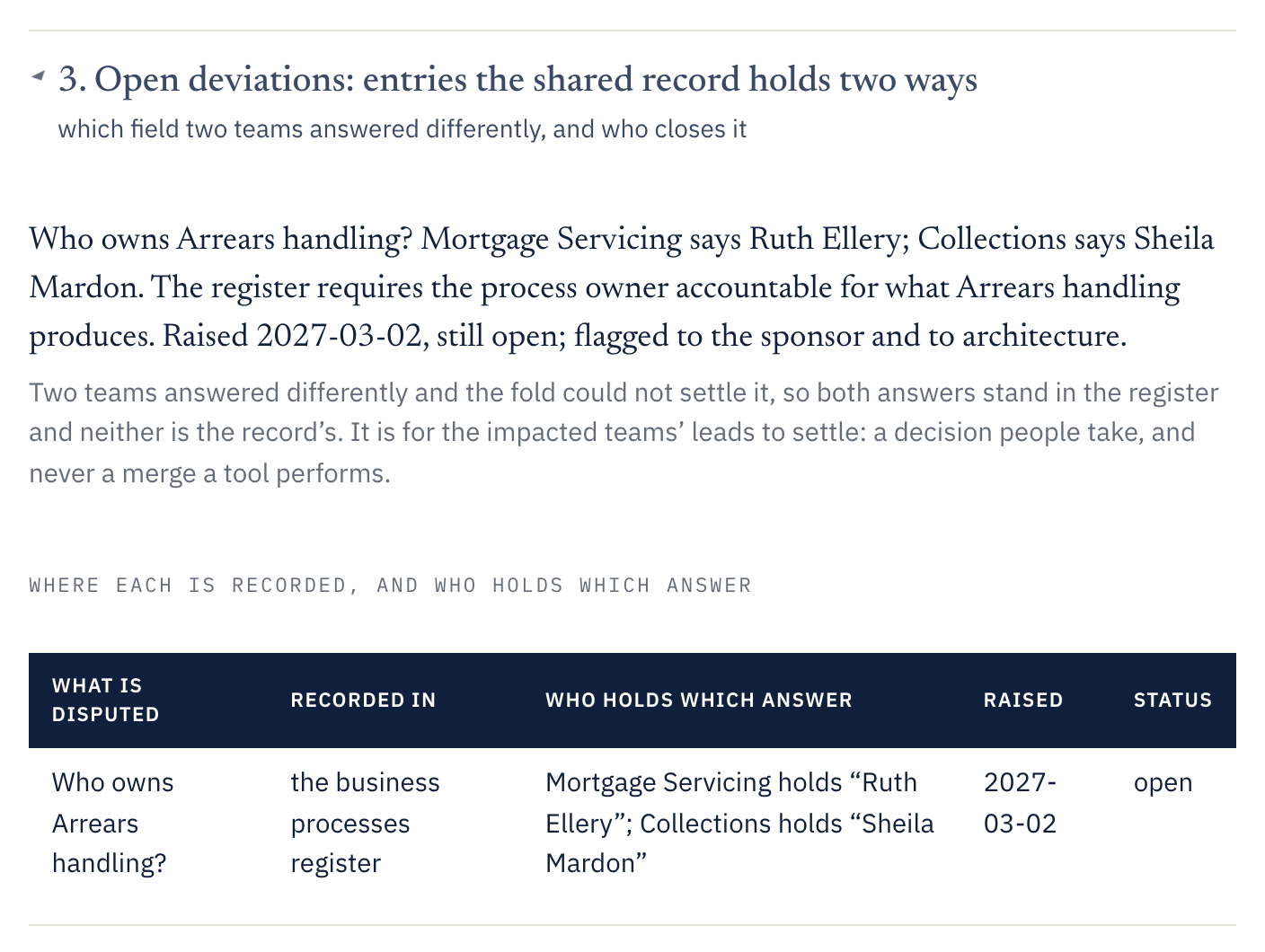
In our fictitious building society, Calderbank, two teams name different owners for the arrears process. The sponsor sees the disagreement and can settle it. This is an illustration of the product, not evidence of a customer outcome. Explore the worked example →
See whether the software would help your teams.
Ask for a demonstration →