Evolving your operating model iteratively
As each team works on its assigned use case, the agent skills we provide write down what is true: who is in the team, who owns what, who decided what, what each team and each piece of software is allowed to do, what the work cost, what the firm is exposed to, and whether each of the practices defined as a target is followed. This is a digital twin of your operating model, a model of how the firm works under these new conditions of building. The data collected gives you the confidence to evaluate how your firm’s new operating model needs to evolve: what is working and what needs focus.
The worked example
Calderbank is a mutual building society of about 900 staff. In its sponsor’s words, it lends on the homes of members whose income a large lender’s model will not price, and looks after them when their circumstances change, because the members own it. Its difficulty is that when a member rings up having missed a mortgage payment, the person who answers cannot see that member’s whole situation in one place. The society cannot keep fixing that by writing more software onto the old system that holds the mortgages.
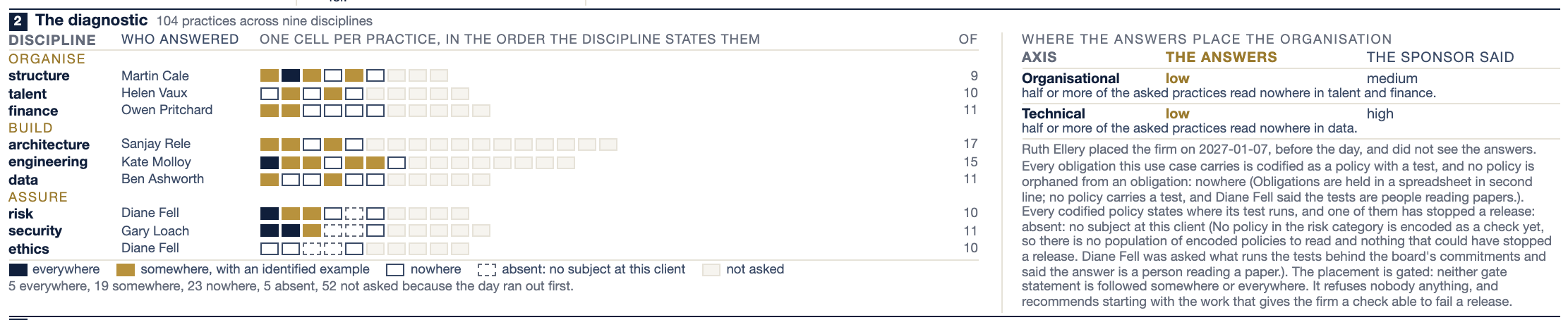
The sponsor is Ruth Ellery, the chief operating officer. Eight discipline leaders answer for the nine disciplines: Martin Cale, director of operations, for structure; Helen Vaux, HR director, for talent; Owen Pritchard, finance director, for finance; Sanjay Rele, head of architecture; Kate Molloy, head of engineering; Ben Ashworth, head of data; Diane Fell, chief risk officer, for risk; and Gary Loach, head of IT security. Nobody answers for ethics, because Calderbank has no ethics function; Diane Fell took that session and said plainly that she does not own it. The seats of chief executive and chief technology officer stand on the organisation chart with nobody in them. Two names recur below from inside the teams: Sheila Mardon, who runs Collections two days a week, and Fiona Weir, the architect on Mortgage Servicing who writes that team’s entries into the record.
The record opened on 14 January 2027 with a one-day diagnostic. Each discipline leader went through their discipline’s practices and said of each whether it happens nowhere, somewhere or everywhere in the society, with an example wherever it happens somewhere. A week earlier the sponsor had written down, without seeing the answers, where she believed the society stood: in the middle on how it organises and decides, and high on technology. The answers placed it low on both.
Ten teams joined between 3 and 24 February, each formed around one use case: Mortgage Servicing on arrears support triage, Collections on arrears arrangement letters, Mortgage Origination on assembling affordability evidence, Customer Relations on summarising complaints, Financial Crime on a transaction-monitoring assistant, Risk Analytics on rewriting the automated valuation model, Data Engineering on an arrears data catalogue, Digital Channels on rebuilding savings onboarding, Treasury on a reporting assistant and Branch Operations on branch scripting. Three of the twelve candidate use cases were selected for the first increment. One, automated affordability decisioning, was rejected before it was scored, because the society’s board has committed that a person decides every declined mortgage application.
Three rounds of customer releases followed: the first from 2 to 23 March, the second from 30 March to 20 April, and the third from 27 April to 4 May, with a new version of the skills applied between the second and third. Every release changed the record, and every change is dated and attributed. What follows is what each of the nine disciplines looked like at each release, and what the sponsor and the discipline leaders decided in between.
Nine disciplines, three increments
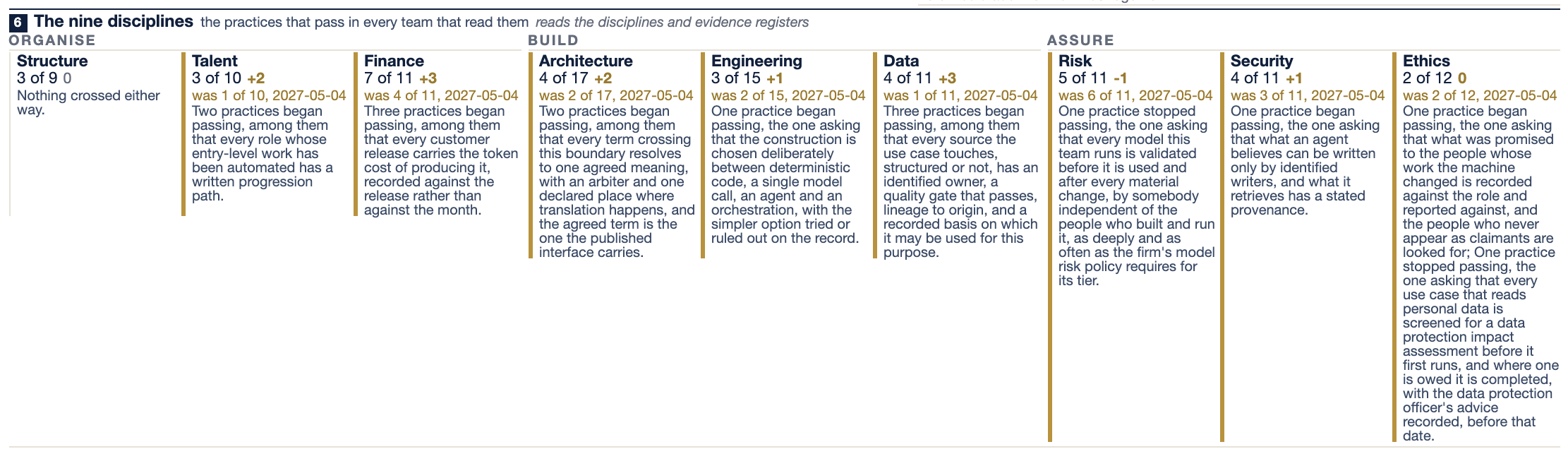
A discipline’s score is the number of its practices that hold in every team tested against them. One team failing a practice keeps it out of the count, and a practice nobody has tested does not count as passing.
| Discipline | First release to 23 March | Second release to 20 April | Third release to 4 May |
|---|---|---|---|
| Structure | 2 of 9 | 3 of 9 | 3 of 9 |
| Talent | 0 of 10 | 1 of 10 | 3 of 10 |
| Finance | 2 of 11 | 4 of 11 | 7 of 11 |
| Architecture | 2 of 17 | 2 of 17 | 4 of 17 |
| Engineering | 2 of 15 | 2 of 15 | 3 of 15 |
| Data | 1 of 11 | 1 of 11 | 4 of 11 |
| Risk | 4 of 10 | 6 of 11 | 5 of 11 |
| Security | 3 of 11 | 3 of 11 | 4 of 11 |
| Ethics | 0 of 10 | 2 of 12 | 2 of 12 |
| All nine | 16 of 104 | 24 of 107 | 35 of 107 |
Practices that pass in every team tested against them. The denominator grew from 104 to 107 because the new version of the skills added one practice each to risk and ethics on 14 April, and Collections proposed one of its own, approved by the sponsor on 30 March.
Structure
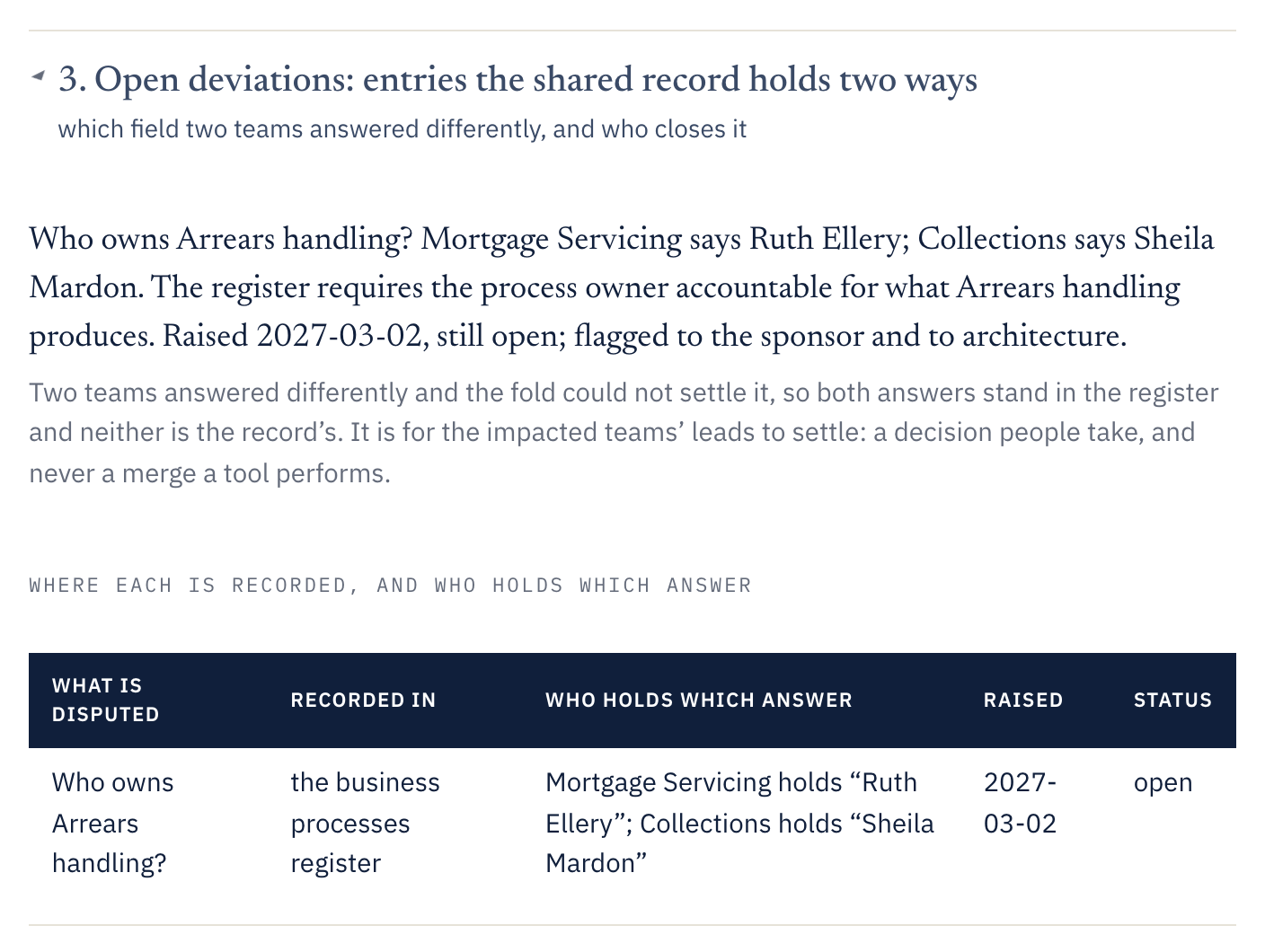
Teams and reporting lines were settled. Who owns arrears handling was not.
- 2 March. Ruth Ellery took ownership of the arrears handling process herself. Collections, which runs the second half of that process, recorded Sheila Mardon as its owner. The record keeps both answers and flags the disagreement to the sponsor; it is still open.
- 2 March. Martin Cale was asked what shape Collections should take and declined to answer until the ownership question was settled. Collections is still the one team whose shape is not on the model.
- Second release. A practice began holding that makes delays visible: every piece of work that ran past its target now carries a note of what it waited for.
- 14 April. At the upgrade, the head of data moved from reporting to the chief technology officer to reporting to the chief operating officer, and a head of arrears seat was created. Martin Cale holds it while the society recruits.
Talent
The sponsor bent one practice to the society’s size and held the rest.
- 14 January. The sponsor set two talent practices aside until 14 April, saying that testing them earlier would be testing her diary rather than the team.
- 3 February. She overruled the practice that asks every team to carry a paid junior shadow. Mortgage Servicing runs a rotating apprentice at half time, because its pod is four people and a sixth paid seat does not exist. Risk Analytics has no shadow; its validation lead reviews every model change a second time instead.
- Second release. Teams are now judged on measures the firm agreed in advance rather than on whatever was to hand.
- 8 April. Helen Vaux wrote a progression path for every role whose junior work has been automated. That practice began holding at the third release.
- 14 April. When the new version of the skills arrived, the sponsor carried her overrule forward rather than amend the practice, saying she was not running a fork of somebody else’s method to protect a headcount argument.
- 4 May. The paid shadow holds in no team. Because it fails everywhere, the record raises it once, for the whole society, rather than ten times.
Finance
Costs became attributable to each release. Value still cannot be counted.
- Second release. One person in each team is accountable for assembling the team’s full cost.
- Third release. Every customer release carries the cost of the AI model calls that produced it, recorded against the release rather than the month.
- Each release. The sponsor set the four targets for every team and raised them each time. Mortgage Servicing’s value-per-cost target went from 0.40 to 0.55 to 0.70. On 31 March she said she would stop raising it until one reading came in above the target. None has.
- Still open. Calderbank pays a flat annual fee for its AI model and nobody has decided what share belongs to each release. Value per cost therefore reads as not counted for every team, and the finance director’s view lists 38 lines of unknown cost.
- Still open. No team’s AI spending stops at a limit without somebody intervening.
Architecture
The record confirmed one strategic choice and refuted another.
- 19 January. The sponsor chose to buy a product for the arrears case workflow and to build in house only the retrieval that puts a member’s whole case in front of the person answering the call.
- 24 March. The first release confirmed that choice for the increment: all five items Mortgage Servicing shipped were retrieval or presentation, and all four steps in its part of the process use its assistant. It is not yet confirmed for the year, because no workflow product has been bought.
- 24 February. The sponsor chose to send every member letter through one correspondence platform. The same day Sanjay Rele judged five capabilities, now and at three years.
- 27 April. The second choice was refuted. Collections sends its arrears letters through the old servicing platform, because the correspondence queue cannot carry the regulatory wording each arrears stage needs. The sponsor said the next diagnosis starts from why one platform could not carry a regulated letter.
- Third release. Two practices began holding: a term that crosses a team boundary now has one agreed meaning, and a declared place where the translation happens.
Engineering
A standing approval from the change board took days off every release.
- Throughout. Every customer-facing change goes to a change advisory board that meets on Tuesdays. The record counts time spent waiting at the board separately from the team’s own time, so the board’s share of each delay is visible.
- Second release. Four of Mortgage Servicing’s six items spent 24 days at the board between them.
- 6 April. Kate Molloy obtained a standing approval from the board for any change touching only the retrieval path.
- Third release. The wait fell to 12 days across two items. The team’s time from backlog to production came in at 19 days against a target of 20, having been 26.4 at the first release.
- Third release. Teams now record which construction they chose for each piece of work (plain code, a single model call, an agent or several) and the simpler option they tried first.
- Still open. Kate Molloy’s objection of 2 March, that a new field in the record duplicates one the delivery tooling already carries, has not been ruled on.
Data
Every source now has an owner, except the one the sponsor chose to live without.
- First and second releases. Nothing moved: one practice of eleven held.
- 30 March. The sponsor accepted that the property valuation feed has no owner, for both teams that read it, to be revisited at the fourth release. A change to the feed reaches the valuation model with no notice to anybody.
- 30 March. Ben Ashworth closed the precondition on the arrears data catalogue.
- Third release. Three practices began holding: every source a use case reads has an identified owner, a quality gate that passes, a lineage to its origin and a recorded basis on which it may be used.
- Still open. The valuation feed’s entry on the risk register passed its review date on 30 March.
Risk
The one discipline that went backwards, because a new practice found a gap.
- 14 January. The sponsor adopted the policies on registering agents and on reviewing accepted risks, and declined the one on decision traceability: the society already had a board commitment covering that ground, and she was not having two rules on one subject.
- Second release. Two practices began holding, among them that obligations considered and not adopted are recorded with a reason.
- 14 April. The new version of the skills added a practice: every model is validated, before use and after each material change, by somebody independent of the people who built and run it.
- Third release. That practice failed. The valuation model and the transaction-monitoring assistant had each been validated by their own owners. Calderbank has two people who can read a valuation model and both work in Risk Analytics, so Diane Fell has to hire a validator or buy the service.
Seven risks sit on the register with no control treating them, each accepted by the sponsor rather than fixed. Three show what that means in practice. Four of the five use cases running at Calderbank look up their arrears facts through one data catalogue, so an outage of it stops four teams rather than one; the sponsor accepted that on 27 April as a high risk. The property valuation feed has no owner, so nobody is told when it changes; that was accepted in September 2026 with a review due on 30 March 2027, which has passed. And the five-year retention rule on financial crime screening has never been tested against the copies made for reports, so a record may outlive its expiry in an extract. Each sits on the chief risk officer’s page with its owner and the date it must be looked at again.
Security
Every agent is registered and owned. One vendor rebuild slipped past review.
- First release onwards. Every agent the society runs was registered before it first ran, with its purpose, its permissions and an owner.
- 3 February. The sponsor accepted a gap on Mortgage Servicing’s assistant: what it may remember, and for how long, is undecided until the fourth release, while it answers members.
- 22 March. A vendor rebuilt the sanctions-list connector that Financial Crime’s agent uses and republished it under the same version number. The review on record, dated 24 March, had read the earlier build. Nobody has reviewed the rebuild, so the practice stopped holding for that team, and Gary Loach answers for it.
- 14 April. Gary Loach signed off the test suite that checks Mortgage Origination’s assistant against instructions hidden in the documents it reads.
- Third release. A practice began holding: what an agent believes can be written only by identified writers.
Ethics
It started with nobody responsible. The sponsor filled the gap one decision at a time.
- 14 January. Calderbank has no ethics function. Diane Fell answered the diagnostic session and said she does not own it. The seat is still empty.
- Before any scoring. Automated affordability decisioning was rejected, because the society’s board has committed that a person decides every declined mortgage application. That commitment runs as a check that fails the build.
- 2 March. The sponsor adopted a decision right: the wording of any automated contact with a member in arrears is approved before it is used.
- 30 March. Collections proposed a practice of its own: every automated contact with a customer in arrears is written to that customer’s record with the reason, where the complaints team can read it. Diane Fell presented it and the sponsor approved it.
- 30 March. The sponsor chose to judge each agent by the whole population of what it does rather than by sample outputs. On 27 April she recorded the choice unresolved: the quality floor was met four times out of four, the population measure was taken on none, and she asked whether a floor without an aggregate is worth having at all.
- 8 April. Diane Fell screened arrears triage, which reads members’ personal data and has run since 9 February, and found it needs a data protection impact assessment. The assessment is not done, so the practice fails for Mortgage Servicing.
- Third release. What the society promised the people whose work the machine changed is now recorded against each role.
The twin at the third release
The one-page snapshot reads six registers and marks whatever changed since the previous release. It shows how the teams are arranged and whom they report to, which team owns which capability, who holds each decision right, whether every role is filled, how the work is funded and which policies run as checks, and the nine disciplines above. It is the page the sponsor reads first, drawn from the record and from nothing else.
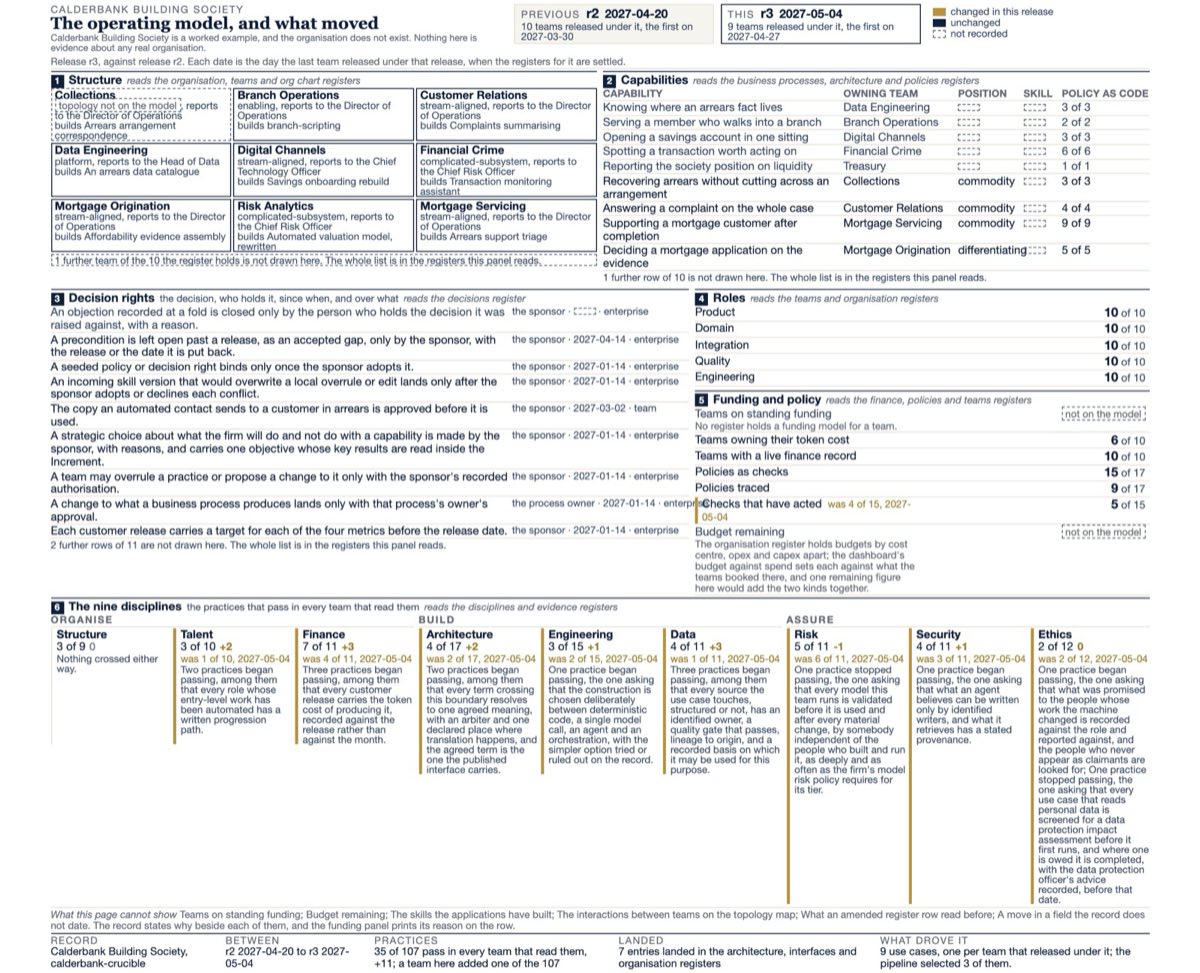
After three increments, 35 of 107 practices hold across the society, up from 16 after the first. Every rise and every fall is tied to a practice, a team and a date, and every decision behind it is on the record with the person who took it. That is what lets a leader say which part of the operating model is working, which part needs focus, and what the next increment should test.
Talk to us.
Contact us →